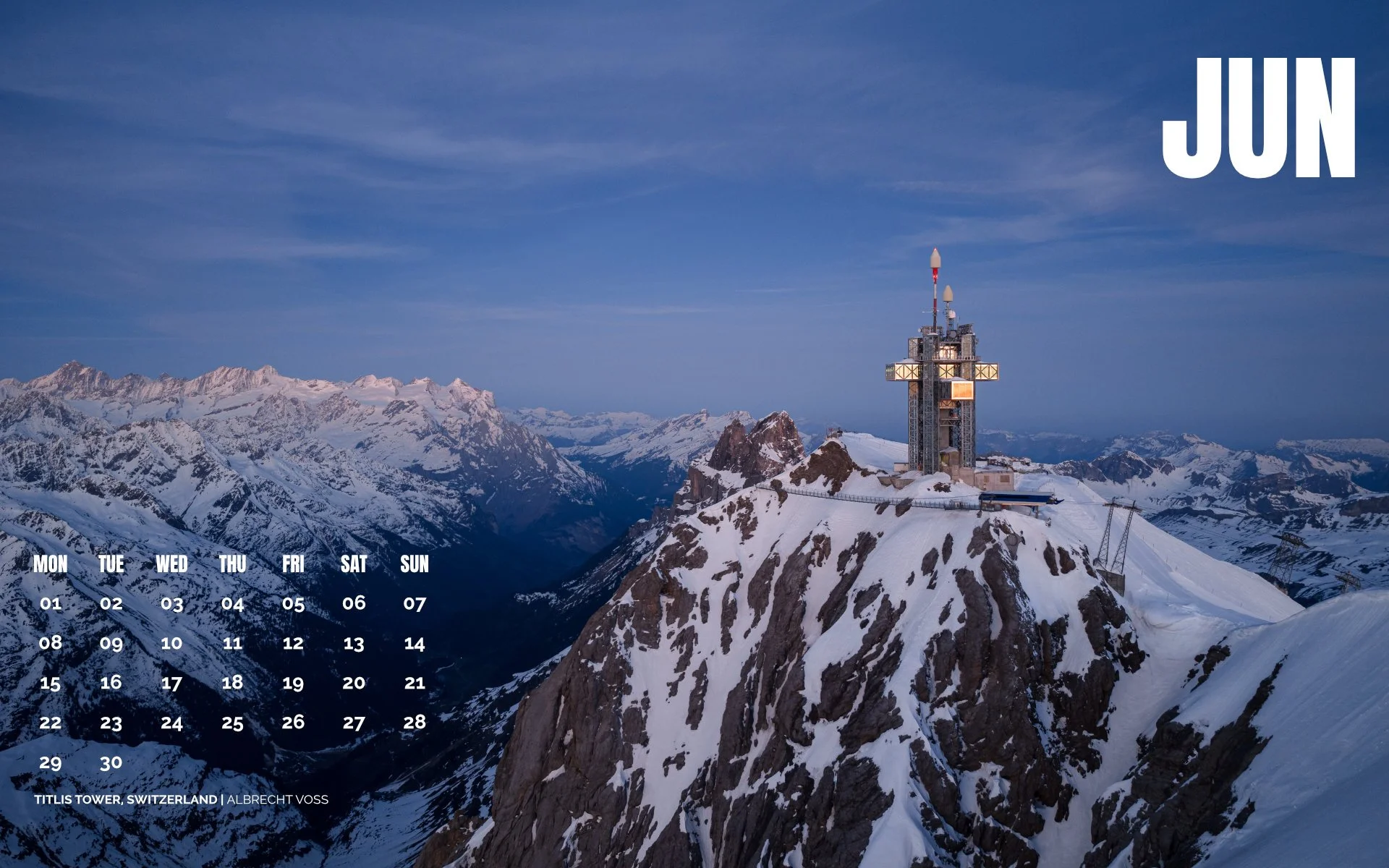
Titlis Tower
Location: Engelberg, Switzerland | Architect: Herzog & De Meuron | Completion: 2026
Image licensing and publication available upon request
Sometimes it takes a few years for things to come full circle.
When I first read about Herzog & de Meuron’s new Titlis Tower in the Swiss Alps in 2019, I was immediately captivated. The revitalization of an existing mountain station, combined with the firm’s unique architectural language and the dramatic landscape of the Alps, captures the very essence of what interests me about architecture: the tension between the raw power of nature, technical challenges, and contemporary design.
The Titlis Tower is a major source of inspiration for my long-term project MODERN ALPINE ARCHITECTURE —a photographic documentation of modern architecture in the Alps. Over the past few years, this project has taken me to remote mountain huts, futuristic museums, and extreme shooting conditions —from glaciers and climbing expeditions to bitterly cold nights under the starry sky. The series has garnered international publications and awards in architecture and photography competitions, and has had a lasting impact on my photographic perspective on remote architecture.
Seven years later, the circle is complete: The German-French television channel ARTE accompanied me while I was photographing the Titlis Tower as part of a documentary on modern architecture in the Alps. Together with my assistant Marcus, I spent two nights at an altitude of over 3,000 meters right on the construction site of the new Titlis mountain station to capture the building in striking nighttime shots amid constantly changing weather conditions.
And so, a month before the official opening, we found ourselves once again on a Swiss mountaintop—surrounded by fog, ice, construction site lights, and one of the most fascinating architectural projects in the Alps.
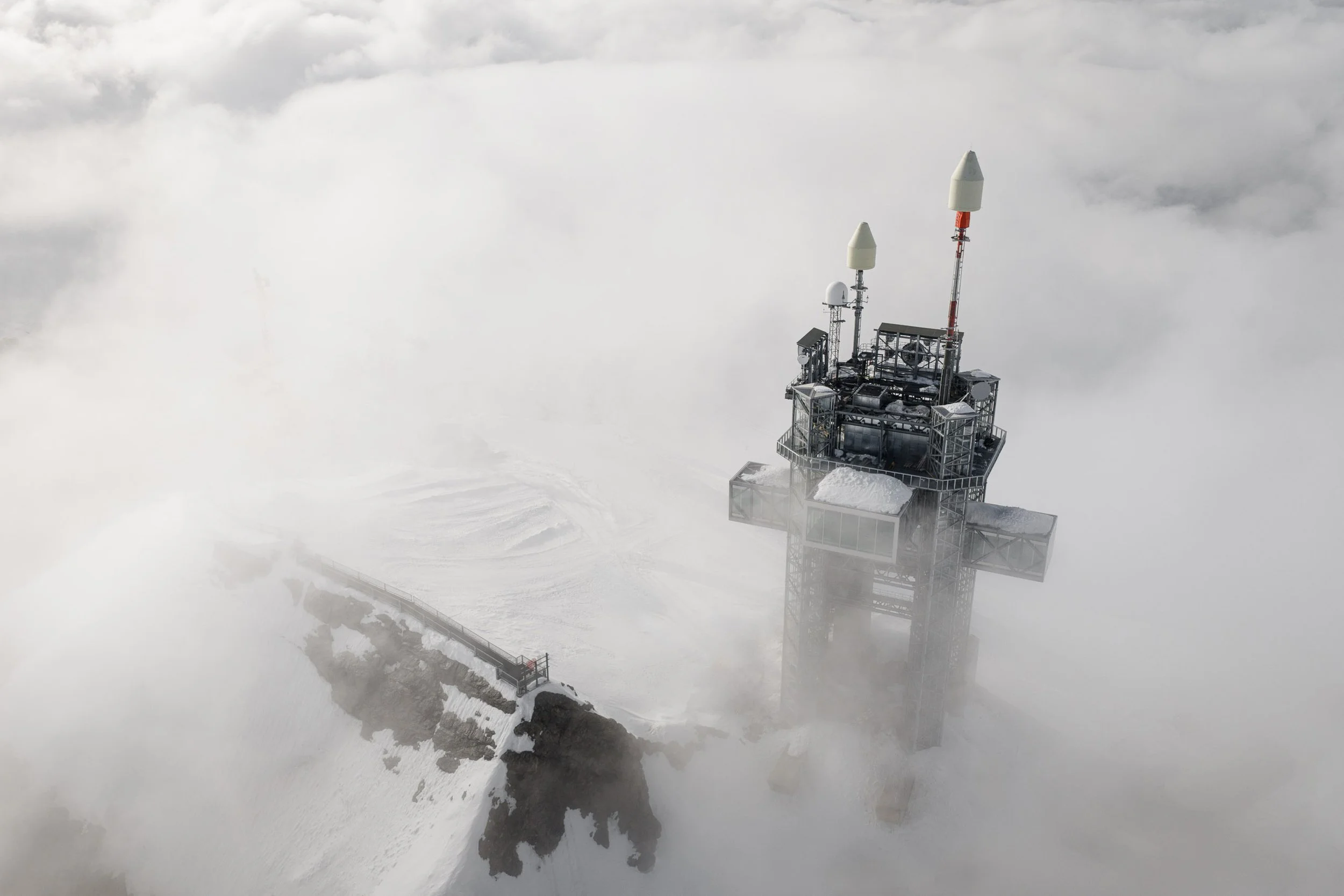
Architectural concept for the Titlis Tower by Herzog & de Meuron
With the Titlis Tower and the future redesign of the mountain station, Herzog & de Meuron, in collaboration with Titlis Bergbahnen, are developing a new generation of Alpine infrastructure. The project is conceived not only as a functional expansion of a tourist hotspot at an altitude of over 3,000 meters, but also as an architectural reinterpretation of the high mountains themselves. The project began with the realization that the existing mountain station, built in the 1960s, no longer meets today’s visitor volumes and requirements. Instead of a purely technical modernization, a comprehensive master plan was developed that fundamentally reimagines the access, orientation, and spatial experience of the summit.
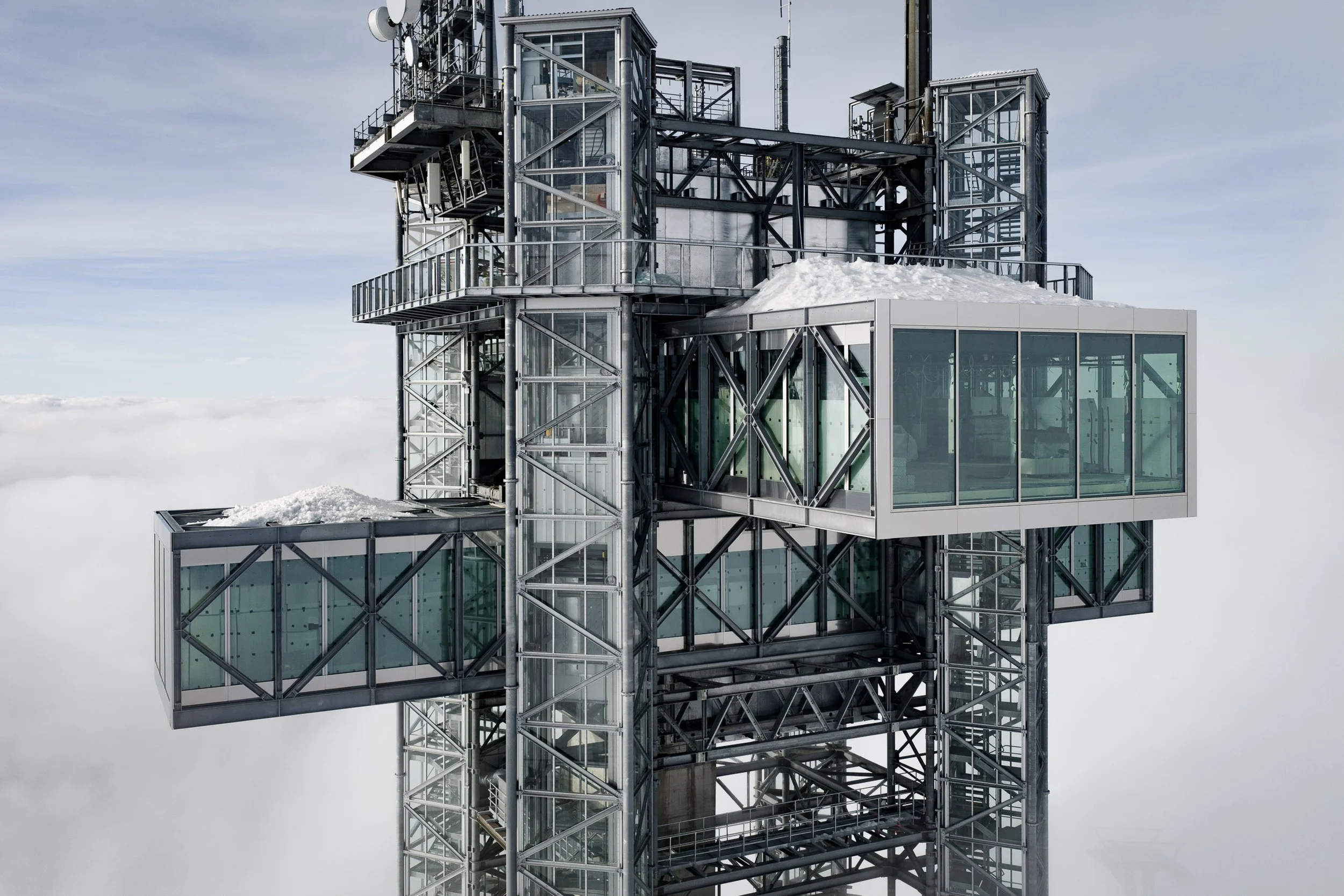
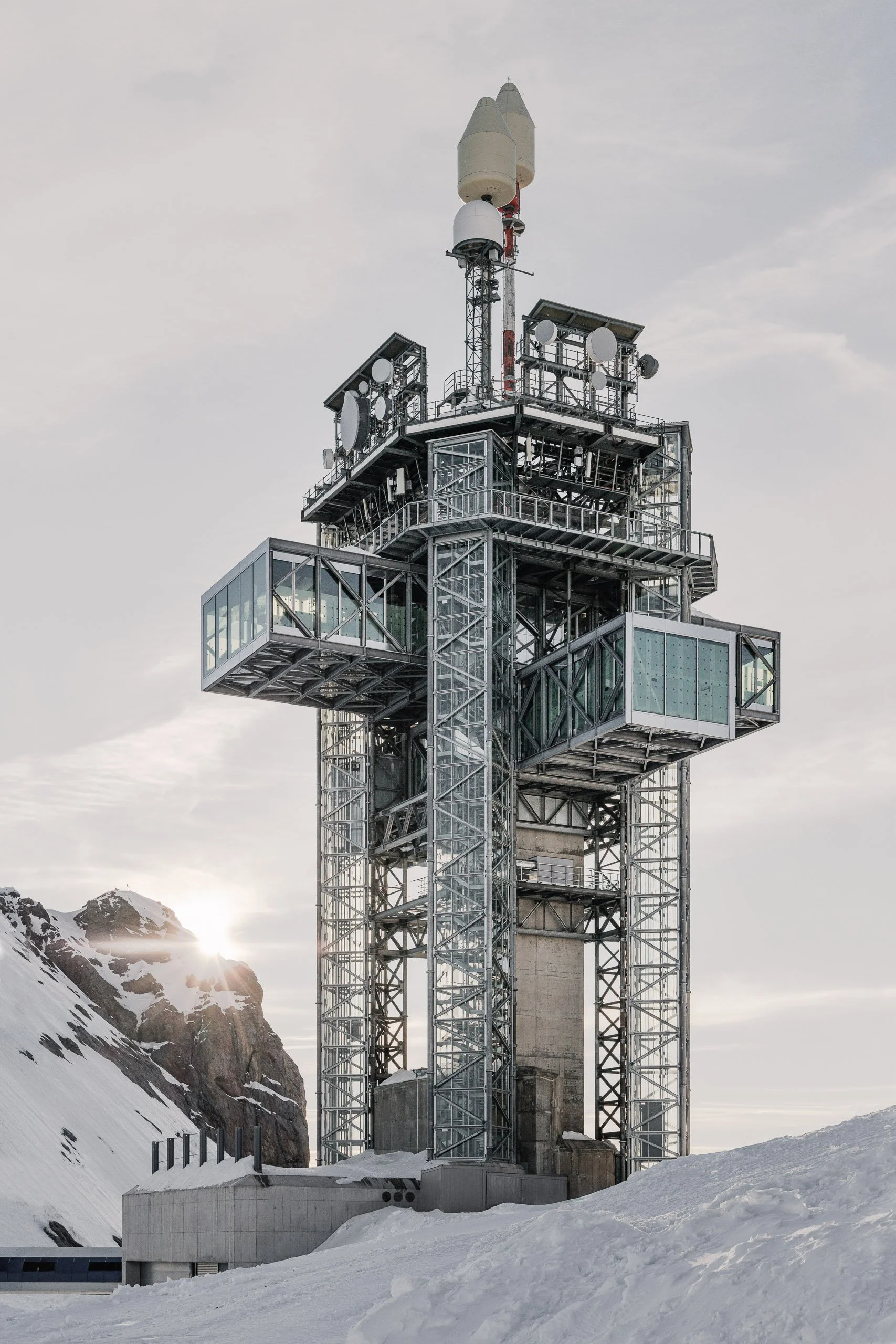
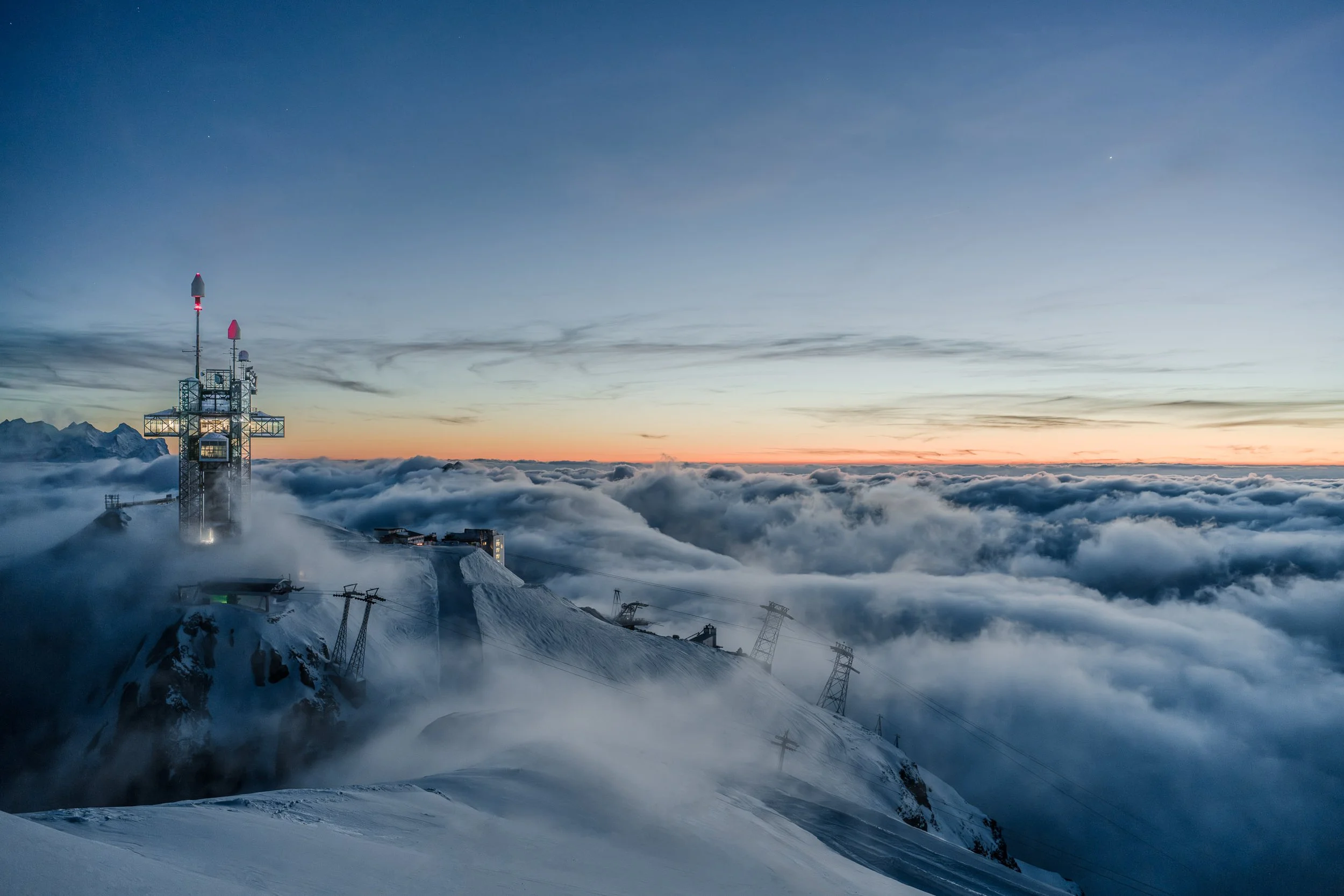
The focal point of the first construction phase is the former Swiss Post directional antenna tower from the 1980s. Herzog & de Meuron are transforming the existing steel structure into a striking cross-shaped form by inserting two horizontal, glass-enclosed volumes, which hover above the glacier and are visible from afar. The former infrastructure building is thus transformed into a public experience space featuring a restaurant, bar, exhibition areas, and an observation deck. Particularly exciting is the building’s vertical circulation. Additional structural and circulation elements integrate elevators and stairs directly into the existing steel structure and connect the tower to the new mountain station via a weather-protected underground tunnel. The result is an architectural project that, despite its extreme location, offers a surprisingly clear sense of spatial orientation.
The future mountain station also embodies this concept. Herzog & de Meuron describe the building as a “flat crystal” that emerges from the rock and integrates almost effortlessly into the Alpine topography. Generous glass surfaces, open steel structures, and new panoramic walkways are designed to create a stronger connection between the interior and the landscape. Here, architecture is not seen as a shield against nature, but as a platform for experiencing the majestic surroundings more intensely.
At the same time, sustainability plays a central role in the project. Despite significantly larger floor areas, energy consumption and CO₂ emissions are to be drastically reduced. The new infrastructure will be operated entirely without fossil fuels and will utilize passive solar gains through its large-scale glazing. Especially in the sensitive high-altitude mountain regions, architecture thus becomes not only an aesthetic statement but also a means of securing the long-term future of tourism infrastructure in extreme climates.
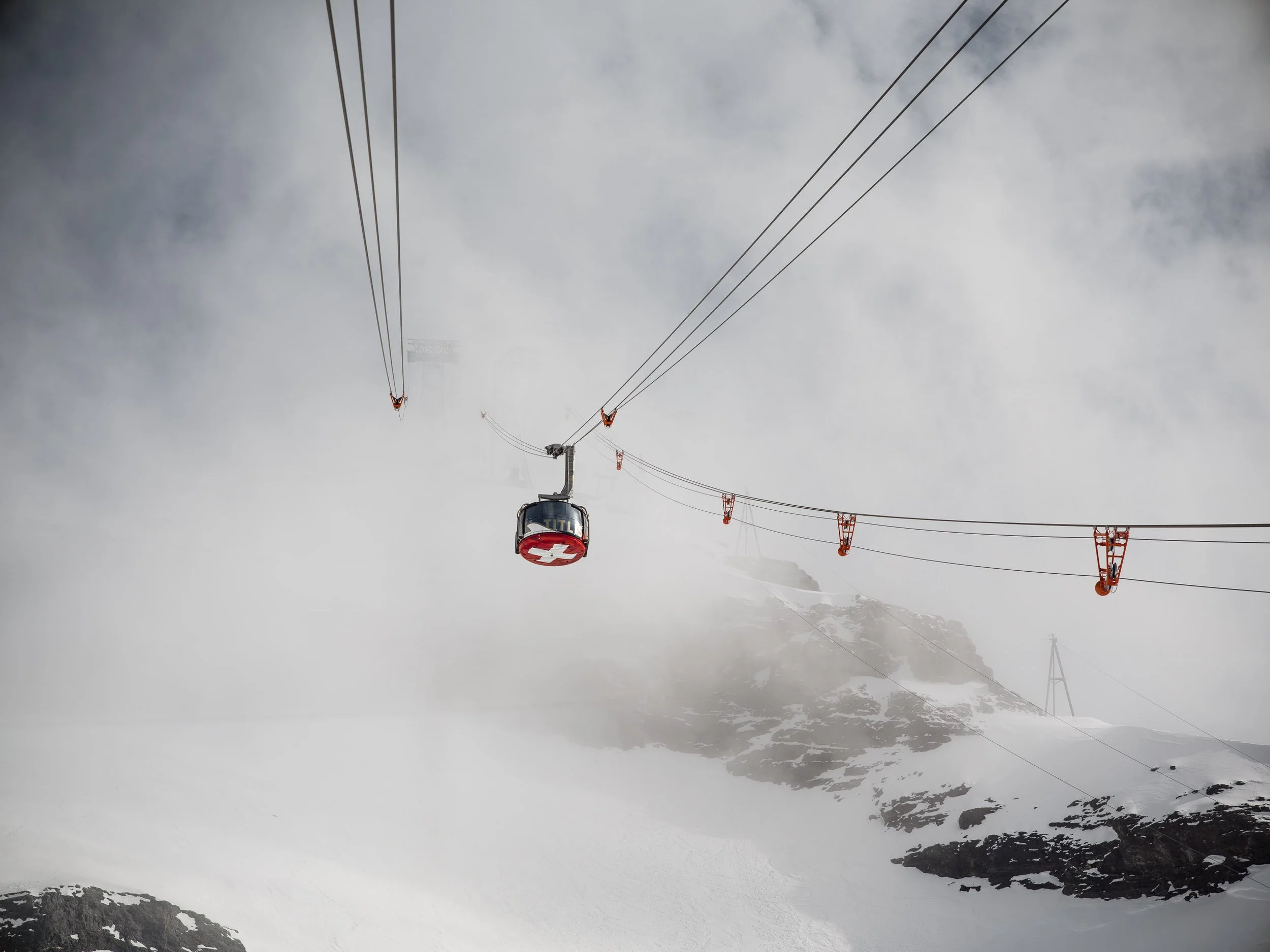
Between ice, fog, and a construction site
Having worked on dozens of photography projects in high-altitude mountain regions, I know just how many challenges documenting a building in such extreme conditions entails. To increase our chances of capturing striking images, we decided to spend two nights right on the mountain.
After a ten-hour drive and an elevation gain of over 3,000 meters, we arrived at the Titlis summit station with our backpacks full and on the last cable car. Immediately following a safety briefing, we set out on our first site inspection. The construction project is located on a small plateau, bordered by a steep rock face dropping several hundred meters on one side and the glacier with its ski slopes on the other. For all its beauty, this terrain harbors numerous dangers. In addition to regular construction site operations involving excavators and cranes, avalanches or rockfalls can occur at any time. Away from the slopes, crevasses lurk, and the snowcats with their taut tow ropes must also be kept in constant view.
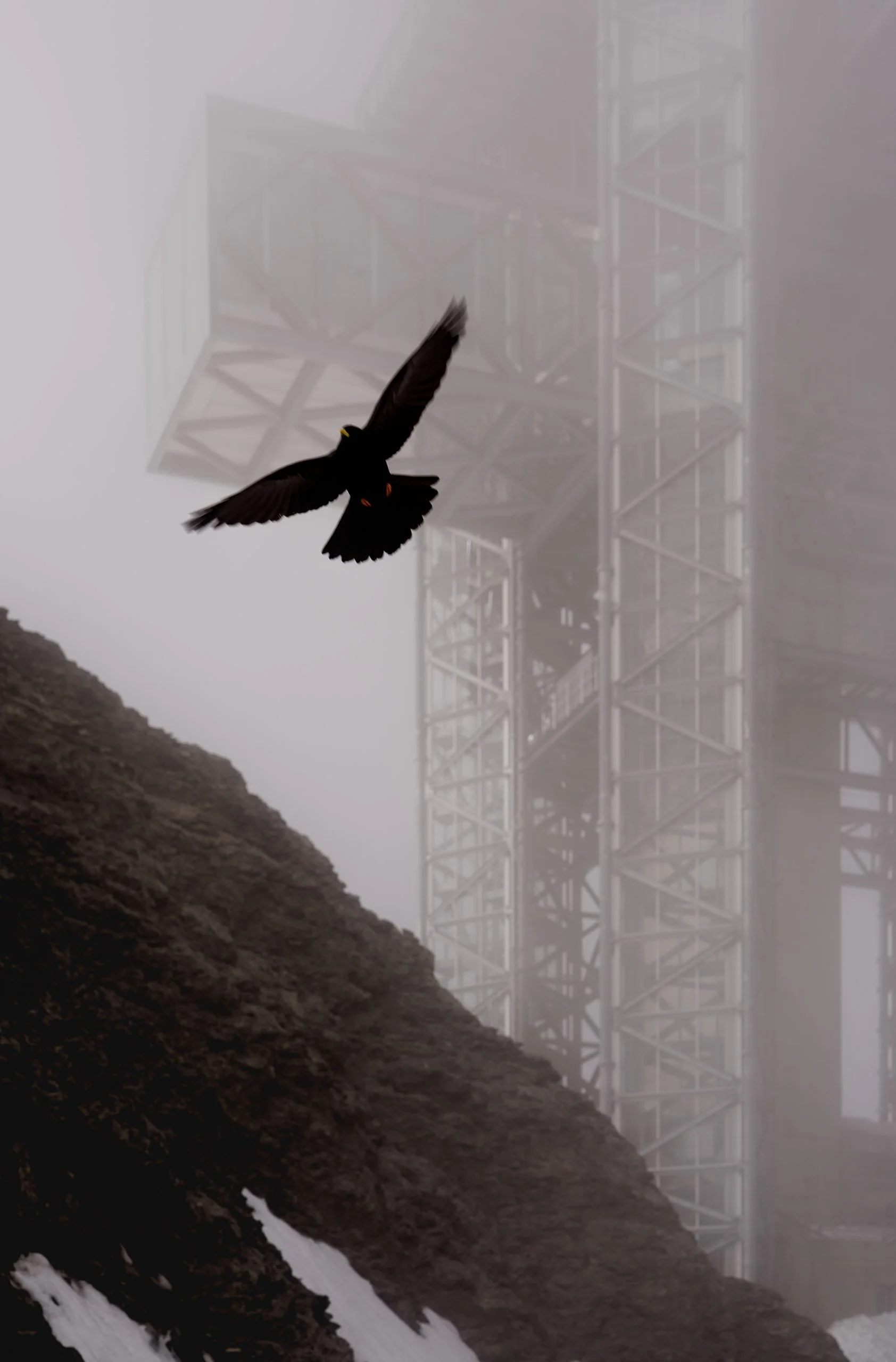
So we started with a drone flight to get a quick overview of potential shooting locations. That late afternoon, the sun kept battling against a stream of thick clouds that were being pushed up from the valley and swirling around the tower. Most of the time, the Titlis Tower remained invisible except from a few meters away. Only from a bird’s-eye view could the building be briefly distinguished from its surroundings.
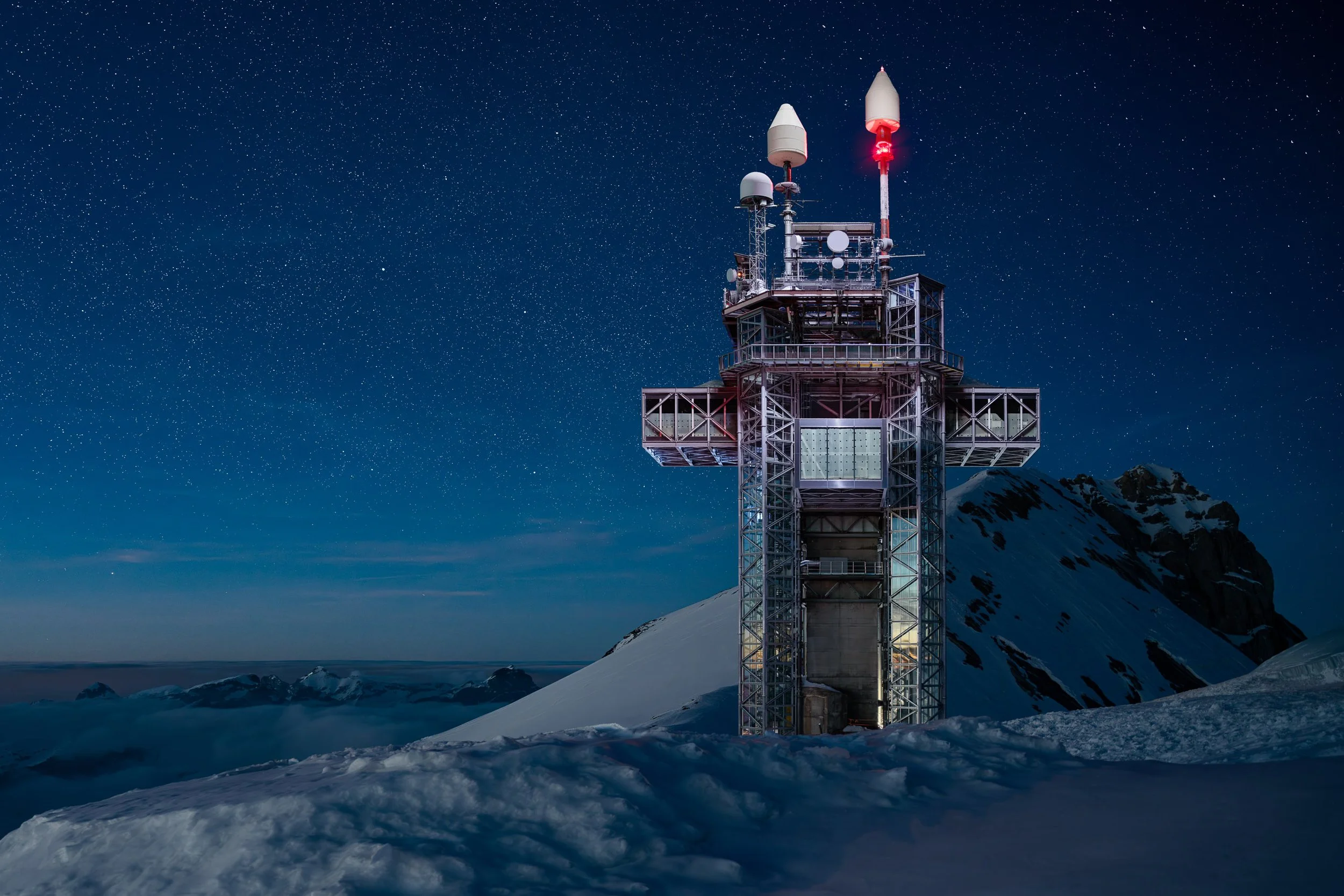
Night Photography at Titlis
The decision on where to shoot the first night scenes was made quickly. We set up the large ARCA-SWISS technical camera with a digital Hasselblad back just a few meters from the tower, in case visibility remained poor. We carried the second camera, equipped with snowshoes, several hundred meters along the summit ridge to another vantage point.
There was just one problem: visibility.
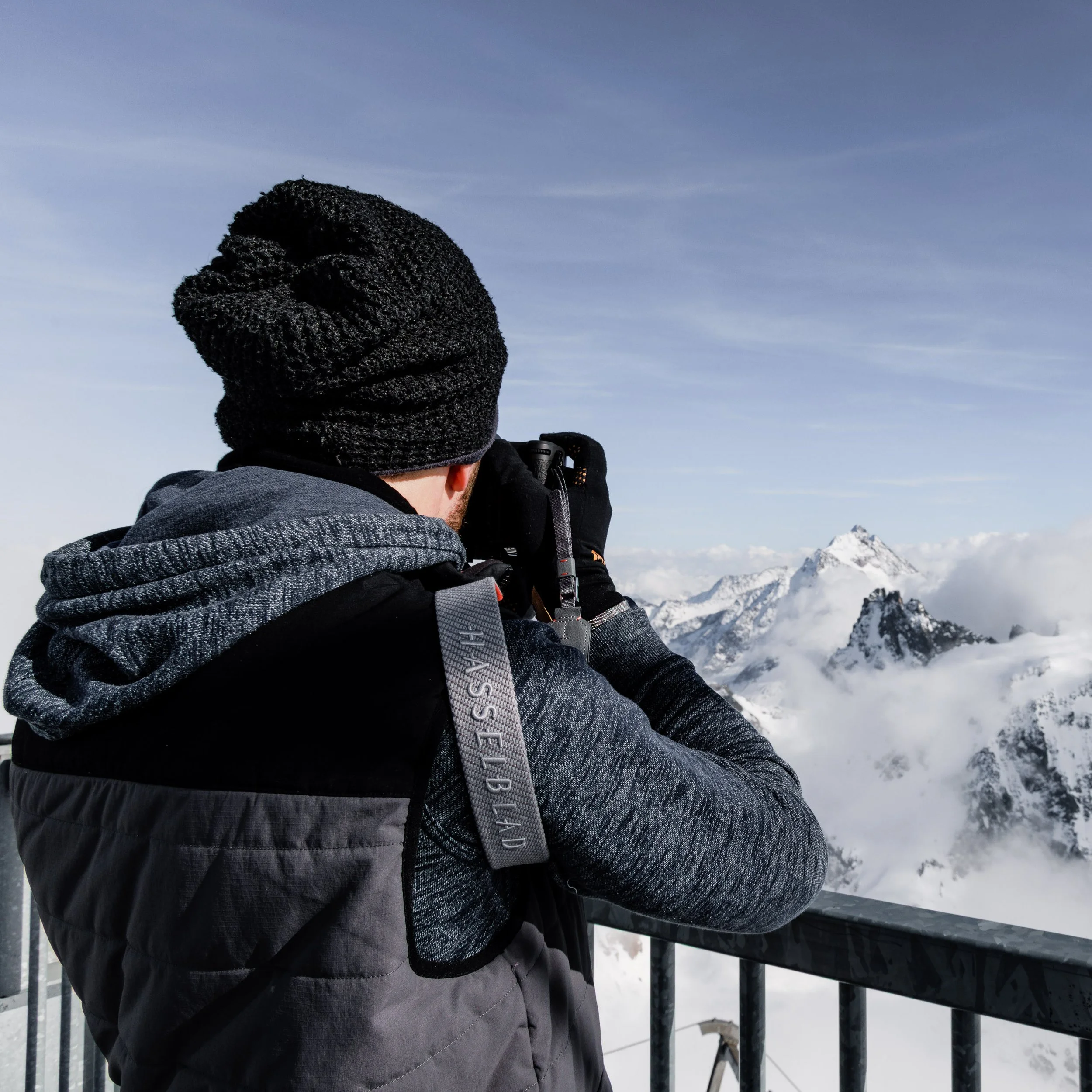
Because of the thick clouds, neither the tower nor any other structure was visible from the ridge, so I couldn’t focus my Hasselblad X2D II with the XCD 38V lens on anything. We waited for over an hour in the freezing fog until, after sunset, the clouds finally began to clear, revealing the view once again. Completely frozen through, we set off on our return journey at dusk, while the two cameras continued to automatically take a photo every 90 seconds. At 2:00 a.m., the Milky Way was finally positioned exactly behind the Titlis Tower. At the same time, the clouds had completely cleared. I launched my DJI Mavic 4 drone into the dark night sky and used it to illuminate the tower with targeted lighting accents.
Sleep was out of the question after that. Instead, we stayed awake until dawn around 5:00 a.m. and continued with more drone flights as the alpine landscape was slowly bathed in a soft blue light. The time just before sunrise is by far my favorite time to shoot. Light and shadow are soft and diffuse, yet clearly defined. At the same time, the first glow of dawn on the horizon reflects off the tower’s glass surfaces, making the building glow warmly. It’s a special feeling to have a place like this all to yourself. With a hot Ovaltine in hand, we finally waited for the sun to rise exactly between the peak of the Titlis and the tower before heading back down to the valley on the first gondola to back up our data and get a few hours of sleep.
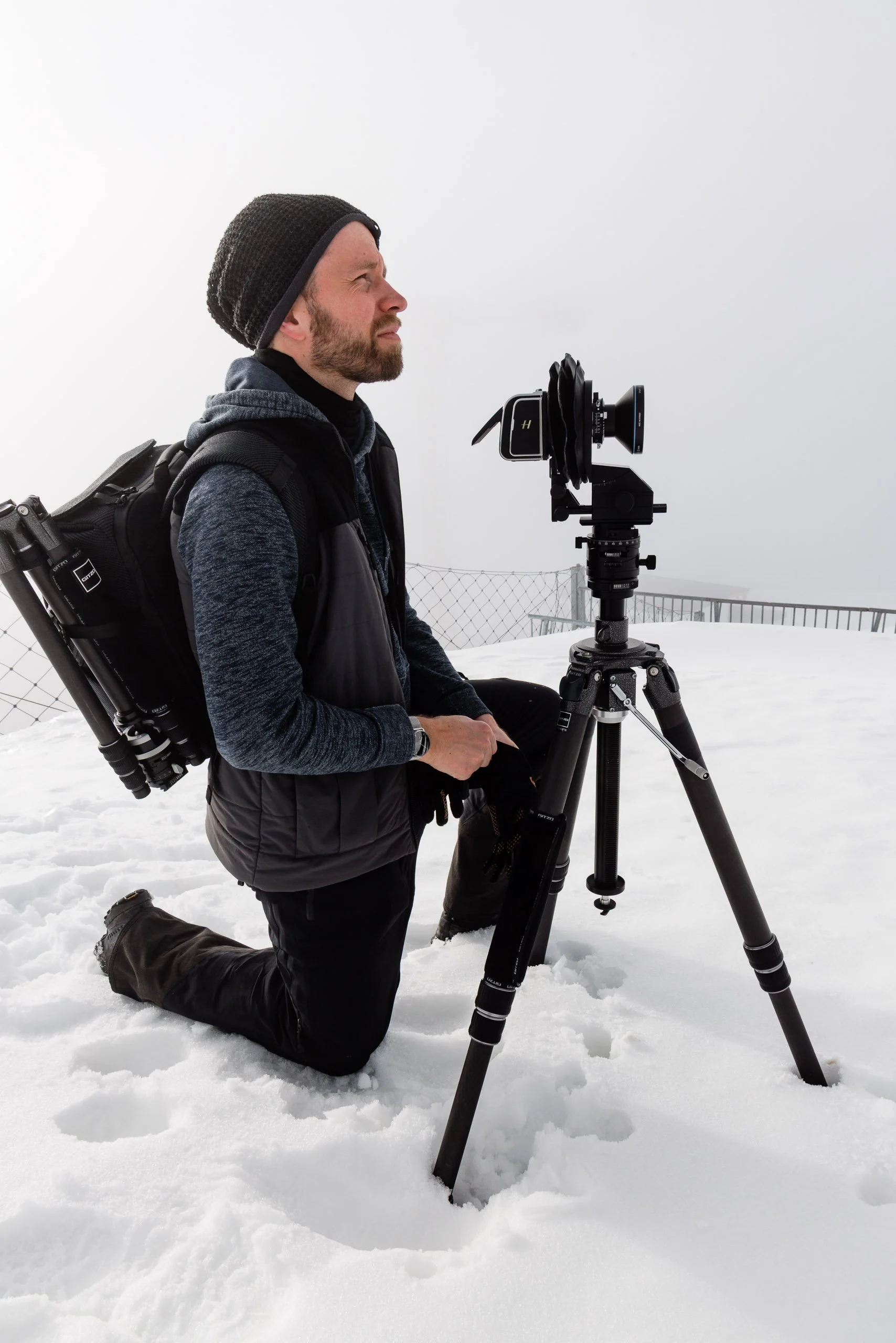
Television production with ARTE
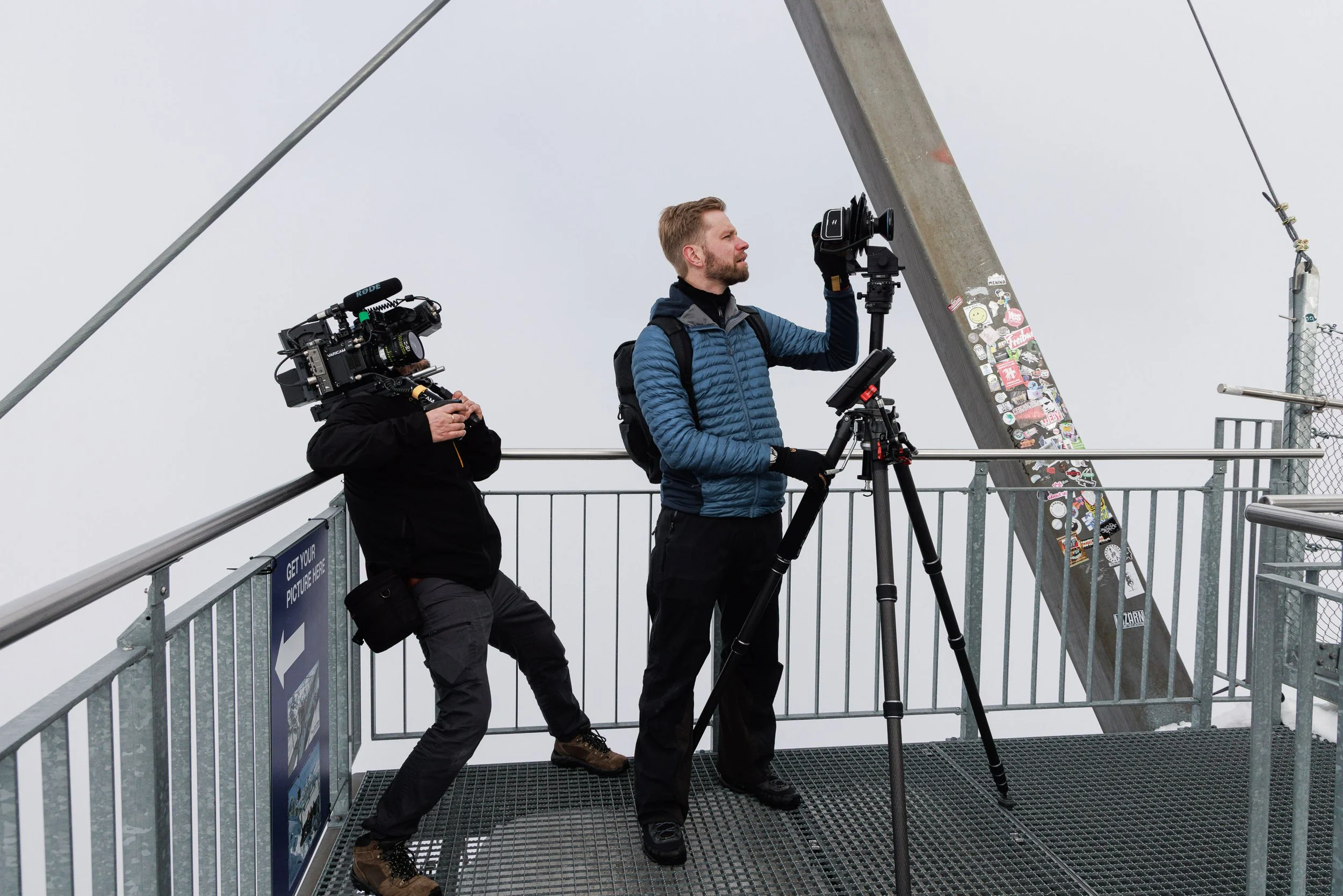
In the afternoon, we met with the cameraman and editor from ARTE to film a documentary on modern architecture in the Alps. Experience has shown that shoots with a larger crew take significantly longer, but they also offer fascinating insights into the photographic process.
The cameraman watches with interest as I attach the ARCA-SWISS Pico to a Rodenstock 32mm HR lens and the Hasselblad CFV 100C digital medium-format back with 100-megapixel resolution, and set it up on my ultra-stable Gitzo Systematic tripod. I use the iPad to check the composition of each shot before taking the picture using the shutter release on the lens.
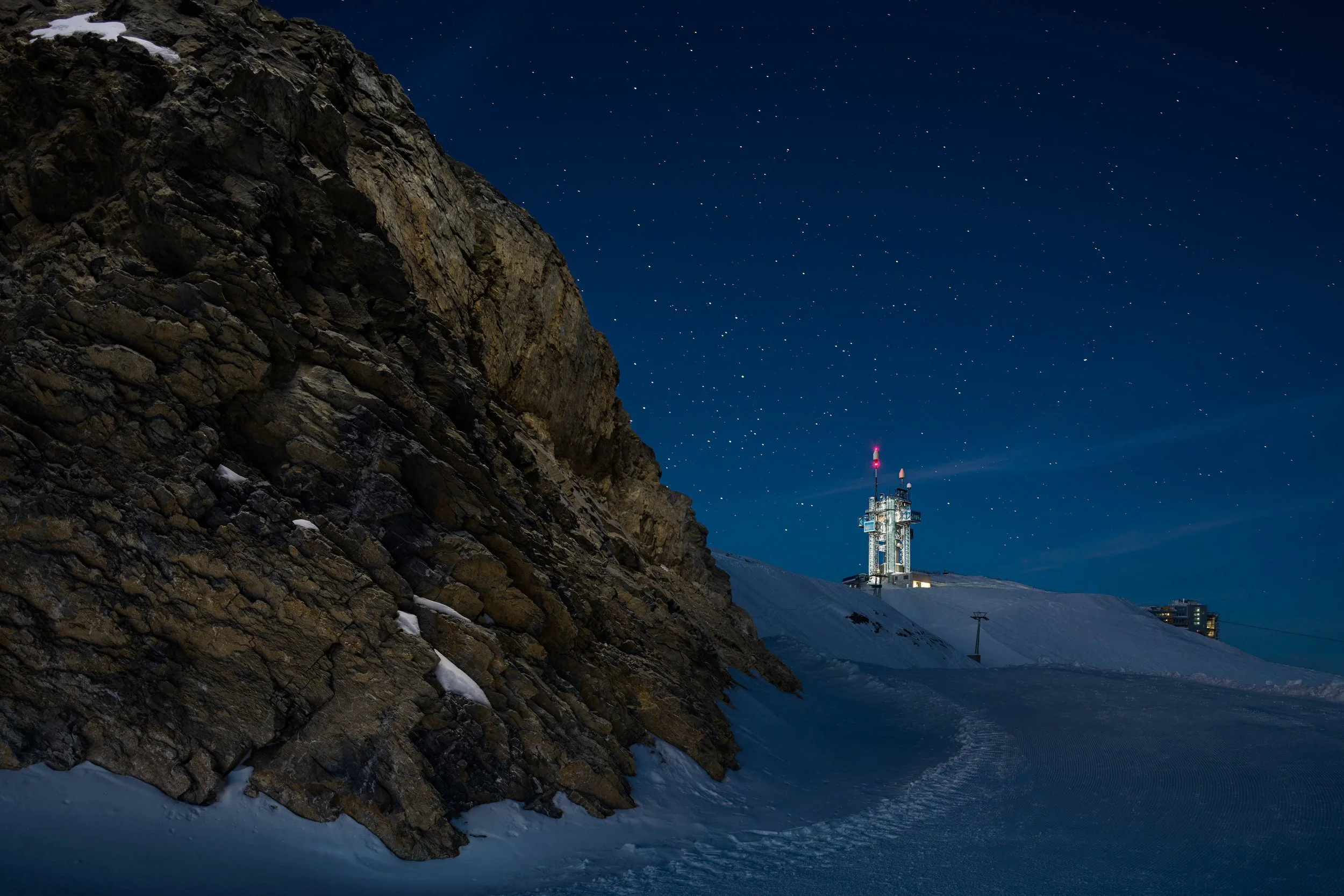
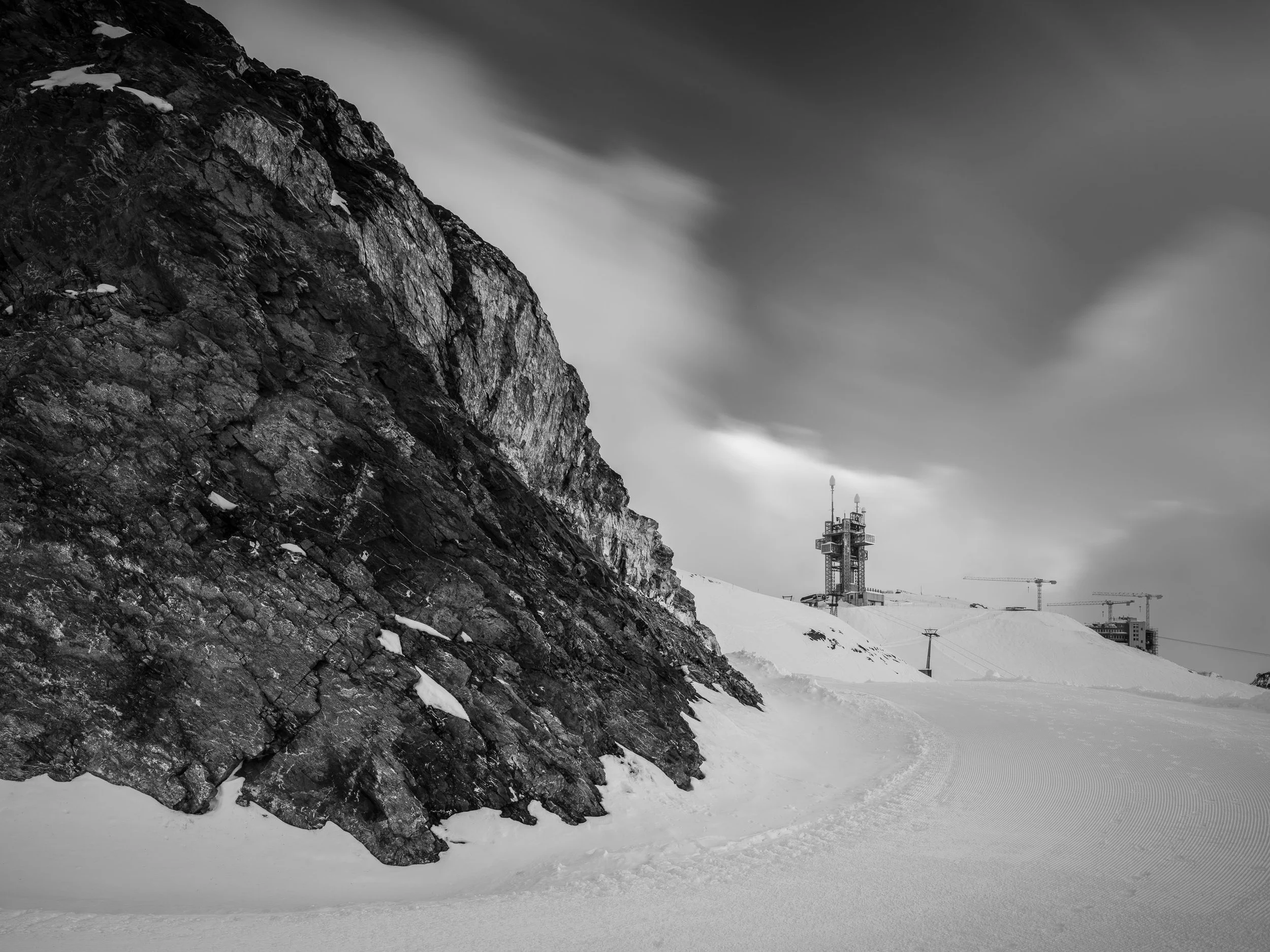
For the night shots, we chose a large rock this time—one that lies about a kilometer from the cable car and separates the ski slopes. Even though the nearly 50-meter-tall Titlis Tower is no small structure, the vast Alpine landscape reduces any man-made object to almost a miniature the moment you view it in relation to its surroundings. It is precisely this contrast that forms the basis of the composition. In the foreground, a ski slope leads the viewer toward the new Titlis Tower, while the silhouette of the cable car station is visible behind it. However, the scene is dominated by the rugged rock face, which has been shaped over thousands of years. Architecture and infrastructure appear here like a toy landscape within a much larger geological dimension.
That evening, too, we waited impatiently for the clouds to part for just a few minutes. In the meantime, I took several black-and-white long-exposure shots that dynamically capture the movement of the cloud formations. However, a starry sky was once again out of the question that evening. At 9:00 p.m., we wrap up filming and head back for a second night at the empty cable car station.
The next morning at 5:00 a.m., the sky is finally clear again. My drone hums over the large boulder, illuminating it from above to highlight its structure. The final shot is in the can. Tired and yet a little wistful, we pack up our equipment. Even though we’ve already captured some impressive shots, the Titlis Tower is still under construction and not yet fully completed. I’m especially looking forward to seeing the new restaurant and the exhibition spaces on the cross-shaped platforms lit up at dusk one day.
Until then, my fascination with architecture in remote locations continues to drive me from one project to the next. The Titlis Tower was not only a photographic documentation project, but also a return to a place that has inspired my work for many years. We wish Titlis Bergbahn a successful opening of the new Titlis Tower on May 30, 2026.
A big thank you to my loyal friend and assistant, Marcus, for his hard work under challenging conditions and for all the behind-the-scenes photos from the production!
Equipment
Camera 1
Camera 2
Lens 1
Lens 2
Lens 3
Tripod
Drone 2
Software
Television Reporting & Licensing
Don't want to miss the ARTE documentary on modern architecture in the Alps? Then sign up now for my monthly newsletter. In addition to a new desktop wallpaper for your computer, you'll be the first to receive information about the documentary's air date.
All images and videos from this project are available for commercial licensing for use in publications, editorial content, and brand communications.
Contact for inquiries